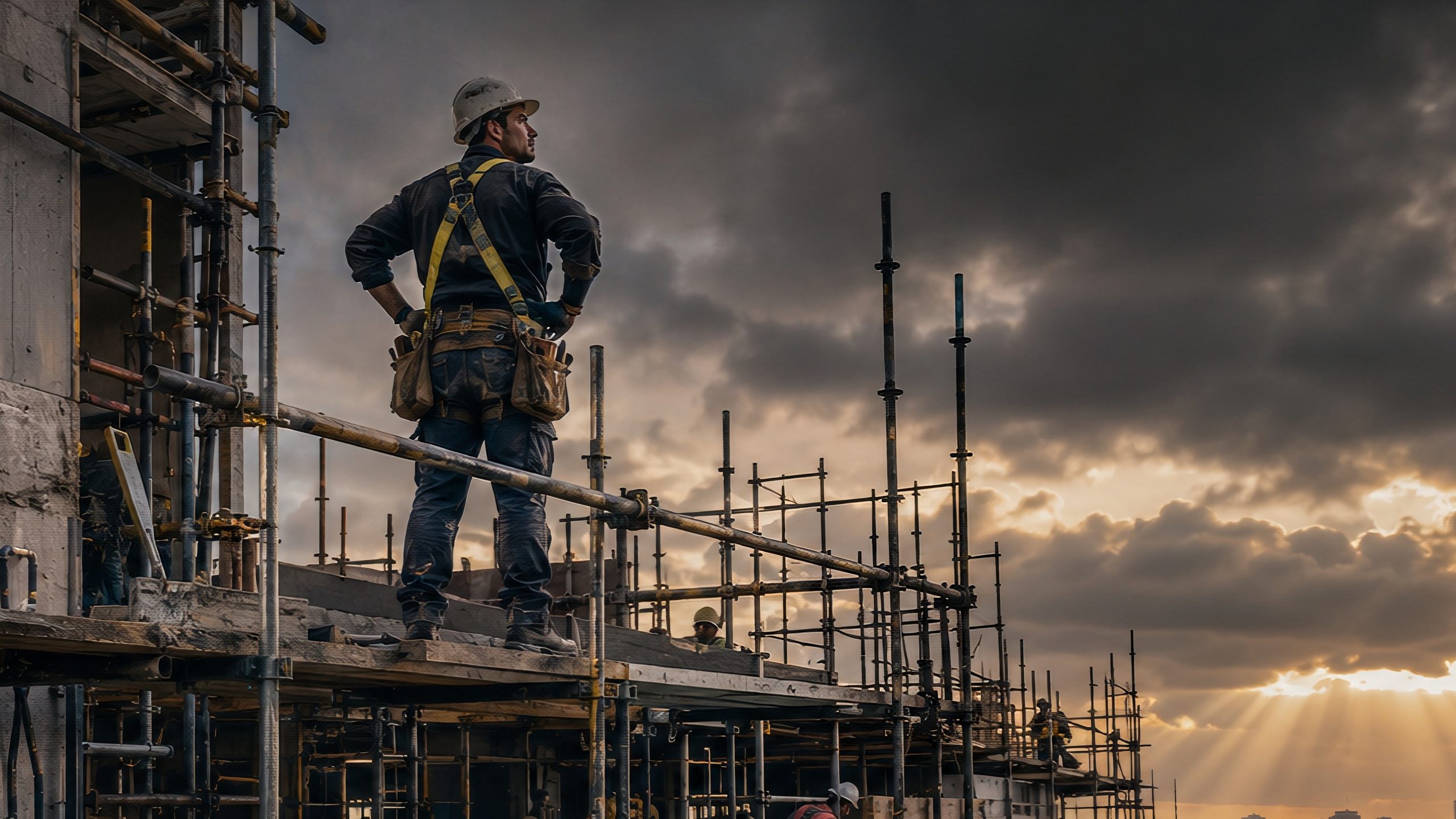
A building under construction is wrapped in a structure that will never appear in the final photograph. The scaffold rises before the walls do, and it belongs, for the length of the project, to no single trade. The electrician stands on planks the mason left behind. The painter finishes on platforms the glazier used the week before. Nobody built the scaffold for himself alone, and nobody who climbs it today built it.
The phrase that the end justifies the means has survived mostly as a warning against men who excuse damage by pointing to the blueprint they claim to be serving. But the scaffold complicates the warning. The end, here, is simply a wall reached, a beam set, a window sealed before the rain comes, and the means is something as ordinary as a colleague holding a level steady, a foreman relaying advice from thirty years on other sites, a supervisor covering a shift because someone’s child was sick that week. Nobody objects when access to the platform is given first to whichever trade the schedule requires. The site was designed for exactly this sequence, one crew elevated so that, later, another will be.
What complicates matters is not the sequence itself but what happens once a worker forgets he was ever standing on borrowed planks. The man who receives the platform today rarely pauses to consider whose earlier labor made his footing possible, and rarely imagines that next month, on another site, he will be the one holding the level for a stranger. He speaks instead of his own competence, as if the platform appeared beneath him because he had earned height, rather than because the rotation of trades required his presence there that week. This is where the phrase earns its bad name, not in the structure of mutual debt itself, but in the erasure that lets each man on the scaffold believe he built it alone.
Seneca, writing on the exchange of favors, argued that a benefit given is not a transaction closed the moment it is repaid, and that the man who keeps count of what he is owed has misunderstood the entire arrangement. He is describing something closer to a scaffold than a ledger. The plank does not remember which foot stood on it first. The favor does not remember which hand extended it.
Construction sites have their own version of the tragedy of the commons, though it rarely gets named that way. It is not usually a crew stripping the scaffold for scrap or refusing to share tools, the sins that get written up in safety reports. It is quieter than that. It is the senior hand who no longer remembers being the apprentice someone else walked up the ladder, who now treats every request for help as an interruption rather than a turn in a rotation he was once granted himself. The site does not collapse from theft nearly as often as it hardens from this kind of memory loss, one man’s convenience slowly rewritten as merit, until the whole crew is made of men who believe they arrived at height unassisted.
What the scaffold finally demonstrates, without any interest in softening the demonstration, is that balance on a site is not a policy anyone enforces from above. It is a structure that holds only as long as enough hands keep walking its length, remembering both directions, the platform they were given and the one they will eventually have to give. The moment a man stops walking that length, the moment his own bay of the building becomes the entire site to him, the scaffold is still standing, the sequence is still written into the schedule, but he has quietly recast himself as the architect of his own height rather than one more trade passing through it. He will speak of his own hands until the day the platform is needed elsewhere, and only then, watching it move down the line without him, will he discover that height was never something he owned. It was only ever something he was, for a season, permitted to stand on.